By the Sandra Bornstein Holocaust Education Center
Revolutions do not only emerge through protests or the overthrow of governments. Sometimes they take shape through the difficult work of protecting a people’s history while others attempt to destroy it.
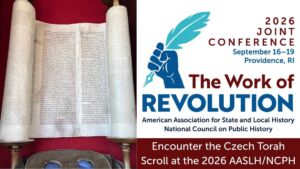
One place conference attendees can explore that idea while visiting Providence is the Sandra Bornstein Holocaust Education Center. As part of the tour “Revolutions in Survival: Jewish and AAPI Histories of Resistance and Cultural Preservation,” visitors will learn about a Czech Torah Scroll connected to Jewish communities in Bohemia and Moravia.
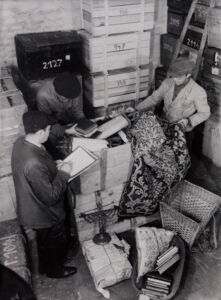
Before the Holocaust, Jews across the Czech lands built synagogues, schools, charitable organizations, and communities that sustained Jewish life for generations.
After occupying Czechoslovakia in 1939, the Germans and their collaborators aimed to erase Jewish life in all its forms. They forced Jews from their homes, deported them to ghettos and camps, murdered entire families, looted synagogues, desecrated cemeteries, and destroyed or seized sacred texts and ceremonial objects from Jewish communities throughout Bohemia and Moravia.
As German authorities organized deportations to Theresienstadt and Auschwitz, Jewish curators, scholars, and communal leaders in Prague tried to salvage what they could from communities already being destroyed. Through the Central Jewish Museum in Prague, and under constant risk of death, they gathered books, archives, ceremonial objects, and Torah scrolls from occupied Jewish communities across the region.
They catalogued belongings from synagogues whose congregants had already been deported and documented the remnants of communal life while knowing they themselves could be placed on the next transport. In the end, the Germans murdered many of the people responsible for this irreplaceable work.
Even so, they preserved more than 200,000 objects, including 1,564 Torah scrolls.
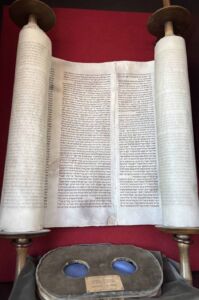
The history of these scrolls speaks directly to the conference theme. While the Germans tried to erase Jewish communities across Europe, those working through the museum fought to preserve evidence that those communities had lived, worshipped, studied, celebrated, and mourned for centuries.
The surviving scrolls remained in Prague under Communist rule, where neglect, state control, and uncertainty again threatened their future. In the 1960s, Westminster Synagogue and the Memorial Scrolls Trust rescued, restored, and distributed the scrolls to synagogues, museums, and educational institutions around the world.
Today, one of those scrolls resides at the Sandra Bornstein Holocaust Education Center. Visitors can stand before a sacred object once held by a Jewish community the Germans destroyed and reflect on the people who used it, protected it, and carried it into the future.
Participants will also hear a presentation by Lois Roman, Trustee of the Memorial Scrolls Trust, titled The Incredible Story of the Czech Torah Scrolls, tracing the journey of the scrolls from wartime Prague to communities around the world.
Join us for Revolutions in Survival: Jewish and AAPI Histories of Resistance and Cultural Preservation during the 2026 AASLH/NCPH Joint Conference. Preregistration is required. Register at https://aaslh.org/annualconference/2026-annual-conference/.